2016年11月30日 星期三
新聞網站「新頭殼」(2009-2016)
2009年9月成立至今已7年多的新聞網站「新頭殼」傳出今年底將熄燈。新頭殼創辦人兼董事長蘇正平今向本刊記者證實此消息,他說,新頭殼不是資源很多的媒體,雖然虧損不多,但因考量未來幾年媒體經營環境可能不會改善,因此董事及股東會日前決議於今年底結束營業。
蘇正平強調,新頭殼是股份有限公司,會依法處理相關事宜,也會善盡社會責任,除對員工的資遣等後續處理一定妥善安排,新聞服務也會提供到年底,不會中斷。他說,目前該公司員工符合《勞基法》資遣規定的有8人,其餘多是定期契約或邀稿作家,因此不適用《大量勞工解僱保護法》的規範。
蘇正平也表示,依法年資3年以上的員工資遣須於1個月前告知,因此昨天已和幾位員工告知此事。他也感嘆:「現在媒體環境大家都很清楚。」一位新頭殼員工今凌晨就在臉書感嘆:「前途一片混亂與茫然。 」據了解,11月27日該公司舉行董事及股東會議,會中做出結束公司的決議。
2009年新頭殼成立茶會時,金溥聰(左)也現身祝賀。
新頭殼網站的正式公司名稱是「先驅媒體社會企業股份有限公司」,2009年9月1日記者節成立,由曾任新聞局長、中央社董事長的蘇正平創辦,曾任公視總經理的胡元輝擔任總顧問,首任總製作(等於總編輯)是中央社前副總編輯莊豐嘉。新頭殼成立茶會當天,甫從壹傳媒離開的國安會前秘書長金溥聰也曾現身祝福。
不過,胡元輝隔年接任卓越新聞基金會董事而離職,莊豐嘉去年也從新頭殼離職,今年另創公民草根媒體《串樓口》,並擔任社長。
「這當然是很可惜的事!」胡元輝感嘆,當初創辦新頭殼的想法很單純,就是希望台灣能有獨立精神的媒體,因資金、資源不足以支撐傳統媒體,因此創立網路原生媒體,並定位為社會企業,因此股東們一開始就以認同價值為主,並不認為是投資,也希望新頭殼「能做多少就發揮多少」。
2009年新頭殼成立茶會,時任總統的馬英九也送花籃祝賀。
胡元輝說,這7年來新頭殼確實發揮了一些作用,包括某種程度引領了現在的網路新聞媒體風潮,以及在部分新聞事件上達到了守望的功能,成績單如何,就留給社會大眾去評價。
新頭殼長期關注政治、媒體改革、社會正義等議題,曾率先報導苗栗大埔案、揭露中國福建省政府付費給《中國時報》置入新聞;此外,包括反核、318學運、反課綱運動等近年的社會運動,新頭殼也都給予大篇幅報導。
2016年11月29日 星期二
THE DOUBLE: A Petersburg Poem by Fyodor Dostoevsky
"It was nearly eight o'clock in the morning when the titular councillor Yakov Petrovich Goliadkin came to after a long sleep, yawned, stretched, and finally opened his eyes all the way. For some two minutes, however, he lay motionless on his bed, like a man who is not fully certain whether he is awake or still asleep, whether what is happening around him now is a reality or a continuation of the disordered reveries of his sleep."
―from THE DOUBLE: A Petersburg Poem by Fyodor Dostoevsky
―from THE DOUBLE: A Petersburg Poem by Fyodor Dostoevsky
he Double, written in Dostoevsky’s youth, was a sharp turn away from the realism of his first novel, Poor Folk. The first real expression of his genius, The Double is a surprisingly modern hallucinatory nightmare in which a minor official named Goliadkin becomes aware of a mysterious doppelgänger–a man who has his name and his face and who gradually and relentlessly begins to displace him with his friends and colleagues. In the dilemma of this increasingly paranoid hero, Dostoevsky makes vividly concrete the inner disintegration of consciousness that would become a major theme of his work. The Gambler was written twenty years later, under the pressure of crushing debt. It is a stunning psychological portrait of a young man’s exhilarating and destructive addiction, a compulsion that Dostoevsky–who once gambled away his young wife’s wedding ring–knew intimately from his own experience. In the disastrous love affairs and gambling adventures of his character, Alexei Ivanovich, Dostoevsky explores the irresistible temptation to look into the abyss of ultimate risk that he believed was an essential part of the Russian national character. The two strikingly original short novels brought together here–in new translations by award-winning translators–were both literary gambles of a sort for Dostoevsky. READ an excerpt here: http://knopfdoubleday.com/…/the-double-and-t…/9781400044702/

《那朵迷路的雲:李渝文集》2016、《郭松棻文集》 (2015);《拾花入夢記:李渝讀紅樓夢》(2011) :郭松棻、李渝合葬中和禪寺靈骨塔
閱讀更多《那朵迷路的雲:李渝文集》:
博客來 https://goo.gl/KYqq9q
博客來-作者-郭松棻
search.books.com.tw/.../prod_search.php?key=郭松棻...
博客來搜尋,作者,郭松棻,郭松棻文集:哲學卷,郭松棻文集:保釣卷,驚婚.
郭松棻(1938-2005)批評文學多產者
2015年
----
旅美作家郭松棻、李渝先後離世,骨灰由兒子自紐約送回台灣,今天合葬於北投中和禪寺。兩人定居紐約半世紀,郭松棻生前立志返鄉,李渝遺囑則表示願與丈夫合葬於大樹下。合葬之地中和禪寺四周綠樹環繞,完成兩人心願。
郭松棻小說多描寫異鄉人的孤寂,台灣是他永恆的鄉愁。郭松棻妹妹郭珠美表示,郭松棻第一次中風時,便表示要返回台定居,可惜因身體欠佳未能如願。李渝過世後,兩人兒子郭志群、郭志虹遵循父母遺志,將兩人骨灰合葬、帶回台灣。
今上午,經過簡單肅穆的佛教儀式,大兒子郭志群將父母骨灰罈安置於中和禪寺靈骨塔。
李渝(1944年1月23日-2014年5月5日)
《延伸閱讀:請給我們海洋——簡˙奧斯婷的《勸導》 》——不只是李渝提到胡適認為《紅樓夢》是自然主義寫法,更因為她融會貫通中外名著的土地、人物與海洋的精神。
約十年前知道志文版《勸導》的中譯筆者,也精讀《法國中尉的女人》和其作者產業故事。
博客來 https://goo.gl/KYqq9q
博客來-作者-郭松棻
search.books.com.tw/.../prod_search.php?key=郭松棻...
博客來搜尋,作者,郭松棻,郭松棻文集:哲學卷,郭松棻文集:保釣卷,驚婚.
郭松棻(1938-2005)批評文學多產者
2015年
----
旅美作家郭松棻、李渝先後離世,骨灰由兒子自紐約送回台灣,今天合葬於北投中和禪寺。兩人定居紐約半世紀,郭松棻生前立志返鄉,李渝遺囑則表示願與丈夫合葬於大樹下。合葬之地中和禪寺四周綠樹環繞,完成兩人心願。
郭松棻小說多描寫異鄉人的孤寂,台灣是他永恆的鄉愁。郭松棻妹妹郭珠美表示,郭松棻第一次中風時,便表示要返回台定居,可惜因身體欠佳未能如願。李渝過世後,兩人兒子郭志群、郭志虹遵循父母遺志,將兩人骨灰合葬、帶回台灣。
李渝(1944年1月23日-2014年5月5日)
- 《拾花入夢記:李渝讀紅樓夢》(台北:印刻文學,2011)
- 很難得的一本讀書、讀畫心得。
《延伸閱讀:請給我們海洋——簡˙奧斯婷的《勸導》 》——不只是李渝提到胡適認為《紅樓夢》是自然主義寫法,更因為她融會貫通中外名著的土地、人物與海洋的精神。
約十年前知道志文版《勸導》的中譯筆者,也精讀《法國中尉的女人》和其作者產業故事。
內容簡介
編輯手札
這真是一次纏綿的編輯經驗,因為圖片和版面與文字的尋找更改都花費了不少時間,一張圖一張圖一個字一個字的修整,還有顏色和版本等圖樣細節,李渝老師以極精準的文字說明紅樓造景與圖畫龐大複雜的來源流變,也不時說到紅樓人物心坎裡的愛憎情思轉化,並放到現代社會價值觀來看,更添趣味,才讓我看到個個紅樓人物如現代偶像劇明星的風采,有文字有畫面的;還有中國文化文學裡豐富充滿底蘊勝過《追憶似水年華》的時代;也不得不愛上賈寶玉或想要有賈寶玉「愛得很寬」的性格,他是那麼「花心」而「癡情」,並且獨一無二。
目錄
小說[編輯]
- 《溫州街的故事》(台北:洪範書店,1991)
- 《應答的鄉岸》(台北:洪範書店,1999)
- 《金絲猿的故事》(台北:聯合文學,2000)
- 《夏日踟躇》(台北:麥田出版,2002)
- 《賢明時代》(台北:麥田出版,2005)
- 《九重葛與美少年》(台北:印刻文學,2013)
藝術評論[編輯]
譯著[編輯]
- 高居翰(James Cahill):《中國繪畫史》(台北:雄獅圖書,1984)
- 巴爾(Alfred H. Barr, Jr.):《現代畫是什麼?》(台北:雄獅圖書,1984)
文學評論[編輯]
- 《拾花入夢記:李渝讀紅樓夢》(台北:印刻文學,2011)
『日本美術年鑑』2014年度(東京 財研究所・企画情報部)
『日本美術年鑑』は、日本国内における美術界の一年間の動向を、基本資料を収集整理してまとめたものです。昭和11年に当研究所美術部の前身である帝国美術院付属美術研究所によって第一冊が刊行されて以来、現在まで59冊が刊行されています。
『日本美術年鑑』は、各巻とも年史・展覧会・文献目録・物故者の四項目から成っており、年史・展覧会は月日順に、文献目録はテーマ分類ごとに、物故者は五十音順索引と没月日順の記事にそれぞれまとめられています。
2013(平成25)年美術界年史 美術展覧会(企画展、作家展、団体展) 美術文献目録 定期刊行物所載文献 美術展覧会図録所載文献(企画展、作家展、団体展) 物故者 | ||
2012(平成24)年美術界年史 美術展覧会(企画展、作家展、団体展) 美術文献目録 定期刊行物所載文献 美術展覧会図録所載文献(企画展、作家展、団体展) 物故者 | ||
2011(平成23)年美術界年史 美術展覧会(企画展、作家展、団体展) 美術文献目録 定期刊行物所載文献 美術展覧会図録所載文献(企画展、作家展、団体展) 物故者 | ||
2010(平成22)年美術界年史 美術展覧会(企画展、作家展、団体展) 美術文献目録 定期刊行物所載文献 美術展覧会図録所載文献(企画展、作家展、団体展) 物故者 | ||
2009(平成21)年美術界年史 美術展覧会(企画展、作家展、団体展) 美術文献目録 定期刊行物所載文献 美術展覧会図録所載文献(企画展、作家展、団体展) 物故者 | ||
東京文化財研究所
東京文化財研究所(とうきょうぶんかざいけんきゅうしょ)は独立行政法人国立文化財機構の下部組織。東京都台東区上野公園に所在する。日本及び東洋の美術、伝統芸能、文化財の保存科学と修復技術について基礎研究を行い、博物館や美術館などからの要請に応じて技術指導や調査を行う。また中華人民共和国、大韓民国、タイ王国、ドイツ、米国などの文化財研究機関と広く学術交流も展開している。現所長は亀井伸雄(元文化庁文化財鑑査官)。
沿革[編集]
2000年、新庁舎が完成し、旧庁舎および黒田記念館から移転、黒田記念館には展示施設が整備された。
組織[編集]
- 研究支援推進部
- 管理室
- 企画情報部
- 情報システム研究室
- 文化財アーカイブズ研究室
- 広領域研究室
- 文化形成研究室
- 近・現代視覚芸術研究室
- 無形文化遺産部
- 無形文化財研究室
- 無形民族文化財研究室
- 音声・映像記録研究室
- 保存修復科学センター
- 保存科学研究室
- 分析科学研究室
- 生物科学研究室
- 修復材料研究室
- 伝統技術研究室
- 近代文化遺産研究室
- 文化遺産国際協力センター
- 国際情報研究室
- 保存計画研究室
- 地域環境研究室
- 国際遺跡研究室(奈良文化財研究所)
黒田記念館[編集]
1924年に没した洋画家・黒田清輝(1866年~1924年)が遺産の一部を美術の奨励事業に役立てるよう遺言したことから、1928年に黒田記念館が竣工された(設計:岡田信一郎)。1930年には、同館に美術に関する学術的調査研究と研究資料の収集を目的として、現在の東京文化財研究所の前身である帝国美術院付属美術研究所が設置された。


脚注[編集]
- ^ 平成14年3月12日文部科学省告示第35号
外部リンク[編集]

2016年11月27日 星期日
MIDNIGHT'S CHILDREN. A Novel of India's Coming of Age Salman Rushdie
“Each book has to teach you how to write it, but there’s often an important moment of discovery.” —Salman Rushdie

"Who what am I? My answer: I am the sum total of everything that went before me, of all I have been seen done, of everything done-to-me."
“I am the sum total of everything that went before me, of all I have been seen done, of everything done-to-me. I am everyone everything whose being-in-the-world affected was affected by mine. I am anything that happens after I'm gone which would not have happened if I had not come.”
―from MIDNIGHT'S CHILDREN by Salman Rushdie
―from MIDNIGHT'S CHILDREN by Salman Rushdie
A classic novel, in which the man who calls himself the "bomb of Bombay" chronicles the story of a child and a nation that both came into existence in 1947—and examines a whole people's capacity for carrying inherited myths and inventing new ones. READ more here: http://knopfdoubleday.com/book/158932/midnights-children/
--from "Midnight's Children" (1981) by Salman Rushdie
光是這選句,沒什麼了不起。不過,這是本長篇小說。
A contemporary classic novel, in which the man who calls himself the "bomb of Bombay," chronicles the story of a child and a nation that both came into existence in 1947—and examines a whole people's capacity for carrying inherited myths and inventing new ones.
MIDNIGHT'S CHILDREN. 此書台灣商務有譯本:午夜之子,有詳註。
Salman Rushdie and Midnight's Children
http://forum.bomoo.com/showthread.php?t=1804紐約時報
April 19, 1981
By CLARK BLAISE
MIDNIGHT'S CHILDREN By Salman Rushdie. |
 he literary map of India is about to be redrawn. The familiar outline - E.M. Forster's outline essentially - will always be there, because India will always offer the dualities essential for the Forsterian vision: the open sewer and the whispering glade, Mother Theresa and the Taj Mahal. Serious English-language novelists from India (often called Indo-Anglians), or those from abroad who use Indian material, have steered a steady course between these two vast, mutually obliterating realities; hence the vivid patches of local color provided by the timeless South India of R.K. Narayan's novels and the cool pastels added by the later fiction of Anita Desai. The Indian novels of Paul Scott and Ruth Jhabvala also fall comfortably between those two poles. For a long time it has seemed that novels from India write their own blurbs: poised, witty, delicate, sparkling.
 What this fiction has been missing is a different kind of ambition, something just a little coarse, a hunger to swallow India whole and spit it out. It needed a touch of Saul Bellow's Augie March brashness, Bombay rather than Chicago-born, and going at things in its own special Bombay way. Now, in ''Midnight's Children,'' Salman Rushdie has realized that ambition.
If I am to do more than describe my pleasure in this book, if I am to summarize and interpret, I would have to start by saying that ''Midnight's Children'' is about the narrator's growing up in Bombay between 1947 and 1977 (and about the 32 years of his grandparents' and parents' lives before that). It is also a novel of India's growing up; from its special, gifted infancy to its very ordinary, drained adulthood. It is a record of betrayal and corruption, the loss of ideals, culminating with ''The Widow's'' Emergency rule. As a growing-up novel with allegorical dimensions, it will remind readers of ''Augie March'' and maybe of Gunter Grass's ''The Tin Drum,'' Laurence Sterne's ''Tristram Shandy,'' and Celine's ''Death on the Installment Plan'' as well as the less-portentous portions of V.S. Naipaul. But it would be a disservice to Salman Rushdie's very original genius to dwell on literary analogues and ancestors. This is a book to accept on its own terms, and an author to welcome into world company.
The ''midnight's children'' of the title are the 1,001 children born in the first hour of Indian independence, Aug. 15, 1947. Two of these babies are born in the same Bombay nursing home on the very stroke of midnight: a boy born to wealth and a boy born to the streets. And, of course, a nursemaid switches babies: a street singer cuckolded by a departing Englishman is given the aristocratic Muslim infant and names him Shiva; a wealthy Kashmiri-descended family, the Aziz/Sinais, is given the ''cucumber-nosed'' English-Hindu and names him Saleem. Shiva and Saleem (the narrator) are destined to be mortal enemies from the stroke of midnight.
Saleem receives all the attention. His birth is celebrated with fireworks, and Prime Minister Nehru sends a letter saying that his fate will forever be entwined with that of India. Growing up on a Bombay estate, he bumps his head one day while hiding in his mother's laundry hamper and discovers a gift for telepathy. From the age of nine, he can enter other lives at will, see through walls, plumb all secrets, including the secret of his true parentage. But his telepathic gifts bring death and destruction and very little happiness. He discovers that every one of the midnight children is miraculously gifted; only Saleem is telepathic, but some can travel through time (and even report that India is destined to be ruled by a ''urinedrinking dotard'') and one can change sex at will. The extravagance of Mr. Rushdie's inventions will call to mind the hovering presence of Gabriel Garcia Marquez; call it a tropical synchronicity.
The midnight children are the hope of the nation, and they await Saleem's calling of a ''midnight parliament.'' The only thing inhibiting Saleem from embracing his political destiny arises from his fear of the murdering street tough Shiva, whom he knows to be the rightful inheritor of all his privileges. And so, because of Saleem's fear and guilt, the gifts of the midnight children are never pooled. When they do finally meet, it is during Mrs. Gandhi's ''Emergency.'' Because of the threat they pose to the Only True Succession, the 581 surviving midnight's children are sterilized, and then treated to an even deadlier procedure: They are sperectomized - drained of hope.
(Perhaps you wondered about the real reasons for the Emergency, the various Indo-Pakistani wars, the deaths of certain Indian and Pakistani political figures? Simple: to destroy Saleem, the Sinais and the gifted extended family of midnight's children. The plot of this novel is complicated enough, and flexible enough, to smuggle Saleem into every major event in the subcontinent's past 30 years. Saleem the Nose - variously called Snotnose, Stainface, Baldy, Sniffer, Buddha and Piece-of-the-Moon - knows).
The complex plotting of the book can be gauged (and its playfulness appreciated) by observing how closely an old seer's prophecy is followed. Of Saleem, it is predicted shortly before his birth: '' 'A son ... who will never be older than his motherland - neither older nor younger. ... There will be two heads - but you shall see only one - there will be knees and a nose, a nose and knees. ... Newspaper praises him, two mothers raise him! Bicyclists love him - but, crowds will shove him! Sisters will weep; cobras will creep. ... Washing will hide him - voices will guide him! Friends mutilate him - blood will betray him! ... Spittoons will brain him - doctors will drain him - jungle will claim him - wizards reclaim him! Soldiers will try him - tyrants will fry him ... He will have sons without having sons! He will be old before he is old! And he will die ... before he is dead.' ''
As a Bombay book, which is to say, a big-city book, ''Midnight's Children'' is coarse, knowing, comfortable with Indian pop culture and, above all, aggressive. Salman Rushdie assumes that the differences between Colaba and Chembur are as important, and can be made as interesting, as the differences between Brooklyn and The Bronx. ''We headed north,'' Saleem notes, ''past Breach Candy Hospital and Mahalaxmi Temple, north along Hornby Vellard past Vallabhbhai Patel Stadium and Haji Ali's island tomb ... We were heading towards the anonymous mass of tenements and fishing-villages and textile-plants and film-studios that the city became in these northern zones. ...'' Its characters speak in many voices: ''Once upon a time there were Radha and Krishna, and Rama and Sita, and Laila and Majnu; also (because we were not unaffected by the West) Romeo and Juliet, and Spencer Tracy and Katherine Hepburn.'' Much of the dialogue (the best parts) reads like the hip vulgarity - yaar! - of the Hindi film magazine. The desiccated syllables of T.S. Eliot, so strong an influence upon other Anglo-Indian writers, are gone. ''Midnight's Children'' sounds like a continent finding its voice.
How Indian is it? It is slangy, and a taste for India (or a knowledge of Bombay) obviously heightens the response. Here is a description of a cafe where Saleem's mother goes secretly to meet her dishonored first husband: ''The Pioneer Cafe was not much when compared to the Gaylords and Kwalitys of the city's more glamorous parts; a real rutputty joint, with painted boards proclaiming LOVELY LASSI and FUNTABULOUS FALOODA and BHEL-PURI BOMBAY FASHION, with filmi playback music blaring out from a cheap radio by the cash-till, a long narrow greeny room lit by flickering neon, a forbidding world in which broken-toothed men sat at reccine-covered tables with crumpled cards and expressionless eyes.'' Very Indian.
Of course there are a few false notes. There is a shorter, purer novel locked inside this shaggy monster. A different author might have teased it out, a different editor might have insisted upon it. I'm glad they didn't. There are moments when the effects are strained, particularly in the early chapters, when an ancient Kashmiri boatman begins sounding like ''The Two-Thousand-Year-Old Man.'' On a more serious level, Mr. Rushdie at first has a difficult time endowing the villains of Indian politics with mythic stature (Grass's Germany made it so easy); petty household intrigues seem more momentous than the misaffairs of state (Marquez's Latin America made it easy too). But with Ayub Khan, the Bangladesh war, ''The Widow'' and her son, the later pages darken quite handsomely. The flow of the book is toward the integration of a dozen strongly developed narratives, and in ways that are marvelous to behold, integration is achieved. The myriad personalities of Saleem, imposed by the time, place and circumstance of his extraordinary birth (''So much, yaar, inside one person,'' remarks a Pakistani soldier, of the Saleem then known as Buddha, the tracker, ''so many bad things, no wonder he kept his mouth shut!''), are reduced to a single, eloquent, ordinary soul. The flow of the book rushes to its conclusion in counterpointed harmony: myths intact, history accounted for, and a remarkable character fully alive.
Clark Blaise's most recent books are ''Lunar Attractions,'' a novel, and ''Days and Nights in Calcutta'' (with Bharati Mukherjee), a memoir. He teaches at Skidmore College.
Books of the Times
IT is impossible to resist a novel that contains the sentence ''My sister the Brass Monkey developed the curious habit of setting fire to shoes.'' Or one that will pause to observe, as it considers an unhappy India, ''Sacred cows eat anything.'' According to ''Midnight's Children,'' guilt is a fog, optimism is a disease, freedom is a myth, fried spiders cure blindness and ''Gandhi will die at the wrong time.'' Nevertheless, Salman Rushdie chortles.
We have an epic in our laps. The obvious comparisons are to Gunter Grass in ''The Tin Drum'' and to Gabriel Garcia Marquez in ''One Hundred Years of Solitude.'' I am happy to oblige the obvious. Like Grass and Garcia Marquez, Mr. Rushdie gives us history, politics, myth, food, magic, wit and dung. He adds, in no particular order, a blind art lover, a poet who is verbless and impotent, some vultures and cobras, a peep show and many clocks, telepathy and the nose as a genital organ.
His children of midnight were born on Aug. 15, 1947, at the stroke of independence for India. Saleem Sinai tells us, ''From the moment of my conception, it seems, I have been public property.'' And why not? Didn't Nehru himself send a personal letter of congratulation? Won't Saleem himself be a ''mirror'' of the new nation? 1,001 Gifted Children
Of course, there are two new nations, whether they like it or not. One of them is Pakistan. And Saleem understands himself to be a Moslem. And when, at the age of 9, in a laundry hamper, he comes to appreciate his telepathic powers, he comes also to understand that there were 1,000 other babies born on that same stroke of midnight. Each has a secret resource which consorts with the occult. Notice: 1,001 gifted children; we have enough tales for Scheherazade. And those siblings, India and Pakistan, would murder in the crib.
Mr. Rushdie, whose other novel, ''Grimus,'' I haven't read, was born in Bombay and now lives in London. Bombay is the viscera of this novel, as Danzig was for Gunter Grass in ''The Tin Drum.'' But the ice-blue eyes of Saleem, a Kashmiri, look back at a history of lakes and mountains, of red sails, at memory itself, which, like fruit, is saved ''from the corruption of the clocks'' by the act of writing.
Partition - into India and Pakistan - is a fraud, like the parted middle of the hairpiece on the bald head of the Englishman Methwold, who insists on observing his particular amenities until the clock ends the colonial occupation. ''The baby in my stomach stopped the clocks,'' says one character. Saleem, considering the future, wonders: ''Was genius something utterly unconnected with wanting, or learning how, or knowing about, or being able to?'' Such a subcontinent doesn't have a chance. Since 1947 it has been a bad Indian movie.
Fragmentation is the theme of the novel, from the sheet with the hole in it through which Saleem's grandfather is permitted to glimpse portions of the body of the woman he will marry, all the way to a dismembering of history. ''We are a nation of forgetters,'' Saleem says, and he isn't even sure of his own father. He is reading aloud, like Scheherazade, his dreams, as if to impress a departed wig.
Mr. Rushdie isn't nice, although he is funny and vulgar. The world of ''Midnight's Children'' is not at all genteel, as the world of Anita Desai tends to be. It is the shadow in Paul Scott's mirror or, perhaps, what E. M. Forster heard in the cave, with a lot of symbolic curry added - the clocks, the dreams, ''the ambiguity of snakes,'' the moon and the silver spittoon, the fishermen and the clowns. He is asking: who broke us apart, and why must we die, fragmented, for a failed India? And 1,001 Plots
Why failure? Mr. Rushdie plays many games; the reader needs to be a loyal modernist. ''Midnight's Children,'' with its 1,001 plots, is an exercise in criticism. Saleem is at once Superman, Sinbad and Pinocchio, not to mention Buddha. Eating, he speaks of ''pickled chapters.'' We are reminded that ''no audience is without its idiosyncracies of belief.'' Unspoken words cause bloat. His ear, the woman Patma who must listen to him read aloud his autobiography, deserts him for a while, and he is unmoored. Of himself, he says:
''I was a radio receiver, and could turn the volume down or up; I could select individual voices; I could even, by an effort of will, switch off my newly discovered ear.'' The signals he is receiving are from the children of the midnight clock; they will die with the nation; they will burn like shoes.
If I understand Mr. Rushdie, he is equally outraged by (1) the English imposition on India; (2) Indira Gandhi's ''emergency,'' which did away with liberal democracy in India, and (3) the novel itself, which can't find out how to explain partition and fragmentation and a hole in the spiritual heart. We occupy this hole, and laugh while clenching fists. I wish Mr. Rushdie's children, all of them orphans of history, would take over the world at dawn. This novel - exuberant, excessive, despairing -is special.
Herodotus: The Histories. Everyman's Library. Newly Translated by Tom Holland. Penguin Classics
"Circumstances rule men; men do not rule circumstances."
--from "The Histories" By Herodotus
--from "The Histories" By Herodotus
Herodotus is not only the father of the art and the science of historical writing but also one of the Western tradition's most compelling storytellers. In tales such as that of Gyges—who murders Candaules, the king of Lydia, and unsurps his throne and his marriage bed, thereby bringing on, generations later, war with the Persians—he laid bare the intricate human entanglements at the core of great historical events. In his love for the stranger, more marvelous facts of the world, he infused his magnificent history with a continuous awareness of the mythic and the wonderful.
企鵝公司這英文新譯本 Herodotus: The Histories.可能是第幾十譯本。
漢譯有北京商務版本等。換句話說。古典的英譯一直在推陳出新。此書評給它高評價。
The father of history
Translating Herodotus
A new version of the most entertaining of historians
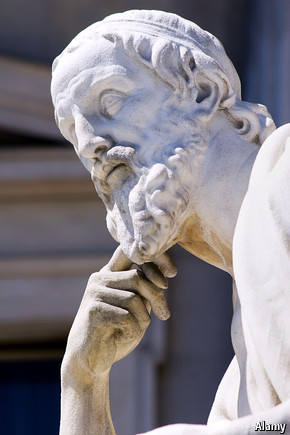 Timeless wisdom
OVER the course of the past decade Tom Holland, a British popular historian, has produced a succession of highly readable works of fiction and non-fiction about the classical world. He has adapted Homer, Virgil and Thucydides for the radio and, as a labour of love and at a rate of a paragraph a day, he has translated Herodotus, the man Cicero called “the Father of History”. Mr Holland’s preface states that “Herodotus is the most entertaining of historians”, indeed “as entertaining as anyone who has ever written”. This lively, engaging version of the “Histories” provides ample support for what might otherwise appear to be a wild exaggeration.
Herodotus wrote the “Histories” around 440BC, in the middle of the most important and exciting century in the history of ancient Greece. The centrepiece of his great work is the conflict, 40 and 50 years earlier, between the Persian empire and the diverse Greek city-states, of which Athens and Sparta were the most prominent. He describes the invasions of Darius and Xerxes and the amazing victories against the odds at Marathon, Salamis and Plataea that preserved the liberty of the people of Europe and sent what was left of the huge armies of invaders scuttling home across the Hellespont.
His account is full of rattling good yarns: Xerxes ordering his men to whip the waters that have destroyed his ships; Spartan soldiers disdaining the teeming enemy by stating that their arrows would provide them with welcome shelter from the sun; the defiant last stand at Thermopylae. At the same time the “Histories” have “something valuable to say to enlightened people…who believe that it is both desirable and possible to learn from history.”
The book is considered the first work of history, but Herodotus was more than just a historian. He was a man with a vast range of interests, a travel-writer, an anthropologist, a geographer who speculated about the sources of the Nile and to some extent a writer of fiction. The Greek word “history” meant something more like “investigation”, and Herodotus’s curiosity led him to explore the structure, customs and past of all the then known world.
He is believed to have travelled widely around the eastern Mediterranean. He observed, he listened and he remembered what he was told. Some of his tales are tall, too tall even. He describes flying snakes, fox-sized ants that unearthed gold dust, men with the heads of dogs and others with no heads at all whose eyes are set in their chests. But, as with reports of the intervention of the gods, he often distances himself by remarking that he is not sure if he can believe what he has been told. He would have been fun to travel with and his book has inspired such authors as David Livingstone and Ryszard Kapuscinski.
Certain themes and lessons recur. Man’s fortune is unstable, warnings are heeded too late, one evil deed leads to another, hubris is succeeded by nemesis. It is too much to expect the British government to add Ancient Greek to the list of subjects in which pupils must become proficient at GCSE (as they must in English and maths), but the minister for education could perhaps introduce some knowledge of Herodotus into the national curriculum. Certainly he should present each of his cabinet colleagues with a copy of Mr Holland’s admirable translation.