"the best of all possible worlds" ;從《老實人 (Candide)》的 "Make Our Garden Grow" /cultivate our garden 說起
1778年的今天,伏爾泰結束了28年的流亡生涯,回到法國巴黎。
「我曾無數次想要自殺,但不知為何,我依然熱愛生命。這種可笑的弱點或許是我們最愚蠢的憂鬱傾向之一,因為還有什麼比渴望背負一個自己樂於拋棄的重擔更愚蠢的呢?還有什麼比厭惡自己的存在卻又緊緊抓住它不放更愚蠢的呢?還有什麼比愚蠢的呢?還有什麼比厭惡自己的存在卻又緊緊抓住它不放更愚蠢的呢?還有什麼比愚蠢的蛇類
——摘自《老實人》
《老實人》講述了一個溫和的男人,儘管命運百般刁難,卻依然執著地相信自己生活在「所有可能的世界中最美好的世界」中。表面上看,這是一部詼諧幽默、妙語連珠的十八世紀經典之作,實則是一部辛辣諷刺的哲學樂觀主義作品,這種樂觀主義宣稱一切災難和人類苦難都是仁慈的宇宙計劃的一部分。這部節奏明快、妙趣橫生、常常令人匪夷所思的法國哲學家筆下的不朽故事,帶領主人公坎迪德環遊世界,最終發現——與他傑出的導師龐格羅斯博士的教誨截然相反——並非一切都盡如人意。這部充滿智慧、才華洋溢、敘事優美的作品,已成為伏爾泰最負盛名的作品。點擊此處閱讀更多:
Voltaire returned to Paris, France on this day in 1778, after being exiled for 28 years.
“I have wanted to kill myself a hundred times, but somehow I am still in love with life. This ridiculous weakness is perhaps one of our more stupid melancholy propensities, for is there anything more stupid than to be eager to go on carrying a burden which one would gladly throw away, to loathe one’s very being and yet to hold it fast, to fondle the snake that devours us until it has eaten our hearts away?”
―from CANDIDE
―from CANDIDE
Candide is the story of a gentle man who, though pummeled and slapped in every direction by fate, clings desperately to the belief that he lives in “the best of all possible worlds.” On the surface a witty, bantering tale, this eighteenth-century classic is actually a savage, satiric thrust at the philosophical optimism that proclaims that all disaster and human suffering is part of a benevolent cosmic plan. Fast, funny, often outrageous, the French philosopher’s immortal narrative takes Candide around the world to discover that — contrary to the teachings of his distinguished tutor Dr. Pangloss — all is not always for the best. Alive with wit, brilliance, and graceful storytelling, Candide has become Voltaire’s most celebrated work. READ more here: http://www.penguinrandomhouse.com/…/candide-and-other-stor…/#
伏爾泰著《老實人》的漢文譯本可能超過十種。我讀過傅雷和沈昉先生的 (徐志摩的......)。
在I. Calvino著《憨第德(或譯老實人),或是關於敘述的快》(Candide, or Concerning Narrative Rapidity)的結論是:「今日人們在生活中的真正選擇都來自於這本書。」
( Italo Calvino 著《為什麼讀經典》 ( Why Read the Classics? 1991 ) ,(李桂蜜譯,pp.114-18)
讀這篇導論的意外收獲不少。譬如說你可以找Paul Klee對本書的26幅插畫來對照。
又譬如說,以前介紹過趙琴的《閹人歌手(Castrato)的興盛與衰亡》,可以在《老實人 第12章 老婦人遭遇的下文》讀到:「我生在那不勒斯,那兒每年閹割二三千名兒童,…..有的因此得到一副比女人還美麗的嗓子,還有的將統治國家。」
這次還發現其中有許多作者對宗教、政治、社會、工作等的看法。特別是末章談工作。據說作者很贊成重農學派的學說。
至於翻譯方面的問題可以談的相當多,我就用末章舉兩例子。
一是伊斯蘭的 dervish 解釋A member of any of various Muslim ascetic orders, some of which perform whirling dances and vigorous chanting as acts of ecstatic devotion.
李譯:「托缽僧」
傅雷;修道士
沈昉:苦行僧
更重要的區別在末句名言:il faut cultiver notre jardin
英文為 cultivate our garden
李譯:必須灌溉我們的花園
傅雷;種咱們的園地要緊---前文都翻譯為「分耕田」
沈昉:把我們的園地種好更要緊---前文都翻譯為菜園子
李的翻譯顯然錯誤。這garden 可以種花、草、菜、果
我起先對於傅雷都翻譯為「分耕田」感到不解。
後來才知道他用心。
因為我查Shorter O.E.D.
CULTIVATE ONE’S GARDEN 之garden 竟然是等同 common(社區之公地,種植放牧等 現在英美都還有這種園...)。
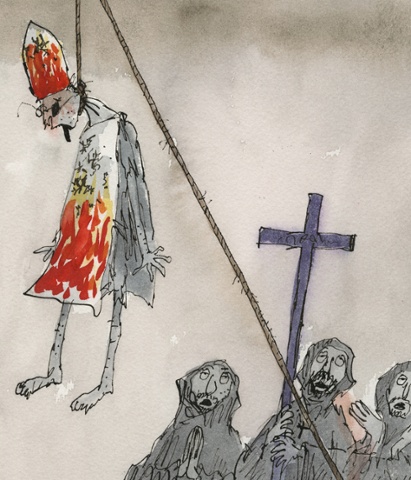
Eternal optimist Dr Pangloss is hanged.
Illustration: Quentin Blake
Pangloss (a coinage from Greek, meaning ‘all languages’) may refer to:
- Pangloss, a fictional character in the 1759 novel Candide by Voltaire: Pangloss is a Leibnizian philosopher, the personal tutor of the main character Candide;
Candide, ou l'Optimisme (/ˌkænˈdiːd/; French: [kɑ̃did]) is a French satire first published in 1759 by Voltaire, a philosopher of the Age of Enlightenment. The novella has been widely translated, with English versions titled Candide: or, All for the Best (1759);Candide: or, The Optimist (1762); and Candide: or, Optimism (1947).[5] It begins with a young man, Candide, who is living a sheltered life in an Edenic paradise and being indoctrinated with Leibnizian optimism (or simply Optimism) by his mentor, Pangloss.[6]The work describes the abrupt cessation of this lifestyle, followed by Candide's slow, painful disillusionment as he witnesses and experiences great hardships in the world. Voltaire concludes with Candide, if not rejecting optimism outright, advocating a deeply practical precept, "we must cultivate our garden", in lieu of the Leibnizian mantra of Pangloss, "all is for the best" in the "best of all possible worlds".
Candide is characterised by its sarcastic tone, as well as by its erratic, fantastical and fast-moving plot. A picaresque novel with a story similar to that of a more seriousbildungsroman, it parodies many adventure and romance clichés, the struggles of which are caricatured in a tone that is mordantly matter-of-fact. Still, the events discussed are often based on historical happenings, such as the Seven Years' War and the 1755 Lisbon earthquake.[7] As philosophers of Voltaire's day contended with the problem of evil, so too does Candide in this short novel, albeit more directly and humorously. Voltaire ridicules religion, theologians, governments, armies, philosophies, and philosophers throughallegory; most conspicuously, he assaults Leibniz and his optimism.[8][9]
As expected by Voltaire, Candide has enjoyed both great success and great scandal. Immediately after its secretive publication, the book was widely banned because it contained religious blasphemy, political sedition and intellectual hostility hidden under a thin veil of naïveté.[8] However, with its sharp wit and insightful portrayal of the human condition, the novel has since inspired many later authors and artists to mimic and adapt it. Today, Candide is recognized as Voltaire's magnum opus[8] and is often listed as part of the Western canon; it is arguably taught more than any other work of French literature.[10] In his book of intellectual history Martin Seymour-Smith listed Candide as one of The 100 Most Influential Books Ever Written.
- Editions
- Voltaire (1759).
 Candide. Trans. Tobias Smollett. Wikisource.
 - Voltaire (in French). Candide. Wikisource.
 Quotations related to Candide at Wikiquote
Candide at Project Gutenberg (plain text and HTML)

2014.10.14
On this date in 1982, the "opera house" version of Candide opened at the New York State Theater. Directed by Harold Prince and choreographed by Patricia Birch, the performance received positive reviews and went on to be performed at numerous opera houses.
In his October 14, 1982 review, published in The New York Times, Donal Henahan wrote, "The new 'opera house version' of 'Candide' was performed so brilliantly that one would have thought it had been running for months rather than being mounted as part of the opera company's usual hectic schedule. In fact, the audience gave the composer a standing ovation when he arrived, fashionably late, before the first act, and again before the start of the last act."
Here is an audio recording of "Make Our Garden Grow" from the 1982 New York State Theater production of Candide.
歌詞http://www.stlyrics.com/lyrics/candide/finalemakeourgardengrow.htm
CANDIDE
You've been a fool
And so have I,
But come and be my wife.
And let us try,
Before we die,
To make some sense of life.
We're neither pure, nor wise, nor good
We'll do the best we know.
We'll build our house and chop our wood
And make our garden grow...
And make our garden grow.
CUNEGONDE
I thought the world
Was sugar cake
For so our master said.
But, now I'll teach
My hands to bake
Our loaf of daily bread.
CANDIDE AND CUNEGONDE
We're neither pure, nor wise, nor good
We'll do the best we know.
We'll build our house and chop our wood
And make our garden grow...
And make our garden grow.
(ensemble enters in gardening gear and a cow walks on)
CANDIDE, CUNEGONDE, MAXIMILLIAN, PAQUETTE, OLD LADY, DR. PANGLOSS
Let dreamers dream
What worlds they please
Those Edens can't be found.
The sweetest flowers,
The fairest trees
Are grown in solid ground.
ENSEMBLE (a cappella)
We're neither pure, nor wise, nor good
We'll do the best we know.
We'll build our house and chop our wood
And make our garden grow.
And make our garden grow!
(The cow dies)
VOLTAIRE
Ah, me! The pox!
「潘格羅士講授形而上學,神學、宇宙論,虛無主義,他以令人驚奇的方式證明,沒有無因之果,在眾多可能的世界當中的這個最好的世界上,仁慈的男爵大人的宮殿是所有宮殿中最美的。『已經證明』,他說:『事物不可能被創造成另一副樣子。既然一切都是為了某一個目的而創造的,一切必然用於最好的目的。要記住,鼻子是為戴眼鏡而做成的,所以,我們才有眼鏡。腿顯然是為穿鞋而安排的,於是,我們才有了鞋襪。石頭的創造是為了讓人們開採它用來建造宮殿,因而仁慈的大人才有了美妙的宮殿』」。
這一小段文字大概是伏爾泰諷刺小說《憨第德》當中最常被人引用的一段話。因此,影射萊布尼茨的角色潘格羅士也就成了這位哲人的標準造像。他表面上博學多才,實則迂腐不堪;明明世上充滿罪惡不公與災難,他卻以自己躲在書齋裏想出來的哲學證明「我們的世界,是上帝所創造的一切可能世界當中至為美好的一個」,樂觀到無可救藥的地步。自從伏爾泰以降,每逢發生什麼大事,例如第一次世界大戰與後來的納粹集中營屠殺,西方就一定有作家和學者重提萊布尼茨這句名言,當然是諷刺式的引用。此世如此不堪,你竟然還好意思說它好得不能再好?莫非另一個更美、更善、更公正的世界真的不存在?不值得盼望?不值得追求?
You've been a fool
And so have I,
But come and be my wife.
And let us try,
Before we die,
To make some sense of life.
We're neither pure, nor wise, nor good
We'll do the best we know.
We'll build our house and chop our wood
And make our garden grow...
And make our garden grow.
CUNEGONDE
I thought the world
Was sugar cake
For so our master said.
But, now I'll teach
My hands to bake
Our loaf of daily bread.
CANDIDE AND CUNEGONDE
We're neither pure, nor wise, nor good
We'll do the best we know.
We'll build our house and chop our wood
And make our garden grow...
And make our garden grow.
(ensemble enters in gardening gear and a cow walks on)
CANDIDE, CUNEGONDE, MAXIMILLIAN, PAQUETTE, OLD LADY, DR. PANGLOSS
Let dreamers dream
What worlds they please
Those Edens can't be found.
The sweetest flowers,
The fairest trees
Are grown in solid ground.
ENSEMBLE (a cappella)
We're neither pure, nor wise, nor good
We'll do the best we know.
We'll build our house and chop our wood
And make our garden grow.
And make our garden grow!
(The cow dies)
VOLTAIRE
Ah, me! The pox!
「潘格羅士講授形而上學,神學、宇宙論,虛無主義,他以令人驚奇的方式證明,沒有無因之果,在眾多可能的世界當中的這個最好的世界上,仁慈的男爵大人的宮殿是所有宮殿中最美的。『已經證明』,他說:『事物不可能被創造成另一副樣子。既然一切都是為了某一個目的而創造的,一切必然用於最好的目的。要記住,鼻子是為戴眼鏡而做成的,所以,我們才有眼鏡。腿顯然是為穿鞋而安排的,於是,我們才有了鞋襪。石頭的創造是為了讓人們開採它用來建造宮殿,因而仁慈的大人才有了美妙的宮殿』」。
這一小段文字大概是伏爾泰諷刺小說《憨第德》當中最常被人引用的一段話。因此,影射萊布尼茨的角色潘格羅士也就成了這位哲人的標準造像。他表面上博學多才,實則迂腐不堪;明明世上充滿罪惡不公與災難,他卻以自己躲在書齋裏想出來的哲學證明「我們的世界,是上帝所創造的一切可能世界當中至為美好的一個」,樂觀到無可救藥的地步。自從伏爾泰以降,每逢發生什麼大事,例如第一次世界大戰與後來的納粹集中營屠殺,西方就一定有作家和學者重提萊布尼茨這句名言,當然是諷刺式的引用。此世如此不堪,你竟然還好意思說它好得不能再好?莫非另一個更美、更善、更公正的世界真的不存在?不值得盼望?不值得追求?
The phrase "the best of all possible worlds" (French: le meilleur des mondes possibles;German: Die beste aller möglichen Welten) was coined by the German polymath Gottfried Leibniz in his 1710 work Essais de Théodicée sur la bonté de Dieu, la liberté de l'homme et l'origine du mal (Essays on the Goodness of God, the Freedom of Man and the Origin of Evil). The claim that the actual world is the best of all possible worlds is the central argument in Leibniz's theodicy, or his attempt to solve the problem of evil.
The statement that "we live in the best of all possible worlds" drew scorn, most notably from Voltaire, who lampooned it in his comic novella Candide by having the character Dr. Pangloss (a parody of Leibniz and Maupertuis) repeat it like a mantra. From this, the adjective "Panglossian" describes a person who believes that the world about us is the best possible one.
"Master Pangloss taught the metaphysico-theologo-cosmolonigology. He could prove admirably that there is no effect without a cause, and in this best of all possible worlds the baron's castle was the most magnificent of all castles, and my lady the best of all possible baronesses."
--from CANDIDE (1759) by Voltaire
--from CANDIDE (1759) by Voltaire
Candide is the story of a gentle man who, though pummeled and slapped in every direction by fate, clings desperately to the belief that he lives in "the best of al⋯⋯
更多

沒有留言:
張貼留言