―from NO LONGER AT EASE by Chinua Achebe
Literature, Chinua Achebe liked to say, was his weapon. He railed against the portrayal of Africa, inspired a generation of writers to find their own voices and was unafraid to upset the powers that be. He died on this day in 2013

Chinua Achebe過世了. 現在很少讀小說的我選他的這本文集Hopes and Impediments
From Wikipedia, the free encyclopedia
Hopes and Impediments: Selected Essays, 1965-1987 is collection of essays by Chinua Achebe, published in 1988.[1]Several of the essays caution against generalizing all African people into a monolithic culture, or using Africa as a facile metaphor.[2] The opening essay, "An Image of Africa: Racism in Conrad's Heart of Darkness", challenged the prevailing opinions in the west about Joseph Conrad's depiction of African people.[3] He also discusses several notable authors and shares his opinion on the role of writers and writing in cultures. In a contemporary review, Chris Dunton wrote: "The essays in his new book remind us also how tough-minded, how properly insistent, he can be in exposing false and demeaning ideas about Africa and its culture."[4] The book is dedicated to Professor Michael Thelwell.[5]
Contents
- "An Image of Africa: Racism in Conrad's Heart of Darkness"
- "Impediments to Dialogue Between North and South"
- "Named for Victoria, Queen of England"
- "The Novelist as Teacher"
- "The Writer and His Community"
- "The Igbo World and Its Art"
- "Colonialist Criticism"
- "Thoughts on the African Novel"
- "Work and Play in Tutuola’s The Palm-Wine Drinkard"
- "Don’t Let Him Die: A Tribute to Christopher Okigbo"
- "Kofi Awoonor as Novelist"
- "Language and the Destiny of Man"
- "The Truth of Fiction"
- "What Has Literature Got To Do With It?"
- "Postscript: James Baldwin (1924-1987)"
References
- ^ Achebe, Chinua (1988) Hopes and Impediments: Selected Essays, 1965-1987. Heinemann, ISBN 0-435-91000-0
- ^ Edwards-Yearwood, Grace (December 31, 1989). Africa Is Nobody's Metaphor: Hopes and Impediments by Chinua Achebe (review). Los Angeles Times.
- ^ Grossman, Ron (November 8, 1989). "Damning message proves irresistible", Chicago Tribune.
- ^ Ezenwa-Ohaeto (1997). Chinua Achebe: A Biography, p. 262. Indiana University Press, ISBN 978-0-253-33342-1
- ^ French, Mary Ann (September 12, 1999). "The people's professor: Michael Thelwell, father of black studies at UMass-Amherst, thinks most of his academic peers have sold out the values of the '60s". Boston Globe.
External links
About 8,640,000 results (0.31 seconds)
Search Results
News for ACHEBE

- Chinua Achebe's anti-colonial novels are still relevant today
The Guardian - 16 hours agoNesrine Malik: He traced the dehumanising effects of western cultural arrogance that are still at work today in Iraq and Afghanistan.
- The Zimbabwe Standard - 18 minutes ago
- The News International - 3 hours ago

Chinua Achebe's anti-colonial novels are still relevant today
He traced the dehumanising effects of western cultural arrogance that are still at work today in Iraq and Afghanistan
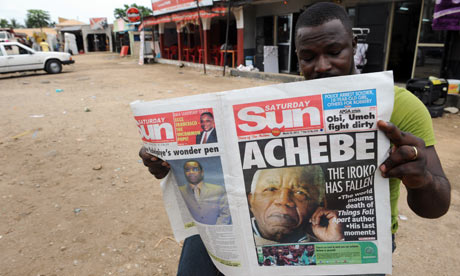
A Nigerian reads a
newspaper featuring a headline on Chinua Achebe's death on 22 March.
Photograph: Pius Utomi Ekpei/AFP/Getty Images
Chinua Achebe's mission statement, by his own admission, was to "set the record straight". His seminal work, Things Fall Apart,
was the first in an African trilogy that set about establishing the
validity of life in tribal Nigeria in the late 19th century, before the
"civilising" colonialism of Christian missionaries arrived.
Achebe paints a picture of village life that is vivid, poignant, but also brutal. With no judgment or steer as a narrator, he succeeds in presenting a community that is robust, with strong mores and religious values, and morally upright characters trying to do their best. He succeeds so well that despite also being shown this life's cruelty, the reader is left reeling with sympathy when the Christian missionaries come to the village and impose their British colonial system, which stamps the old life out as one would kick over an anthill.
As an African Arab growing up in post-colonial east Africa, I had not read before an indigenous interpretation of regional history that wasn't either a non-critical celebration of pre-colonial past, or a wretched condemnation of it as one that must be deficient if it succumbed so easily to invasion. Achebe was the first African writer who painted a non-romantic picture of this tribal life without apologising for the bad, or praising the good. Yes, tribal society Africa was strong and functional, but Christian missionaries would not have made any inroads were there not dissatisfaction with its brutal justice, ethnic discrimination and religious rigidity.
Achebe's writing isn't anything as banal as cultural relativism – something he has been accused of – but a powerful refutation of the fact that before the white man, Africa was a "blank sheet of civilisation". Once things did fall apart, with the west fully taking the reigns of governance either directly or by proxy, what replaced the old way? An uncomfortable mix of modern and traditional that still ended in tragedy.
Perhaps the most relevant of Achebe's works to my generation is No Longer at Ease, the second book of his trilogy, which powerfully exposed the difficulty of navigating a world where one is expected to partake of western secular education and all the values and privileges that comes with it, and still be hostage to the commanding beliefs of one's own culture. It is a heart-wrenching account of the grandchild of the main character in Things Fall Apart, who joins the Nigerian colonial civil service after receiving a British education but struggles to escape the conflicting mores of his family – a tragic modern protagonist with a foot in both camps.
In the third novel, Arrow of God, Achebe elaborates on political disruption and shows how closely the land, agriculture and subsistence of villagers were tied to religion. When the new colonial administrator tries to co-opt the chief priest, the latter rejects the offer and is thrown in prison. In rebellion and religious hubris, he refuses to call for a harvest and the yams rot in the fields. There ensues a famine that results in many converting to Christianity in rejection of a system that the white Christian missionaries convinced them had allowed them to starve. It is a simple narrative of the practical difficulties in governing societies under two conflicting political systems rooted in incompatible values. There are still echoes of this in the present, where western-style democracy is offered as an absolute panacea for all the Orient's ills.
This African trilogy is still relevant today; western intervention is routinely justified under the guise of moral concern, and political turmoil is often sparked by an imposition of western-style governance. In our increasingly global world, civilisational superiority can also be cloaked in ostensibly benign concepts: the promotion of democracy, self-determination, the liberation of women.
Achebe's memoir begins with the Igbo proverb: "A man who does not know where the rain began to beat him cannot say where he dried his body." His work tried to isolate when the defeat of colonised societies began. It is an important question, if we are to carve a path independent of post-colonialist ushering into "civilisation".
Achebe was a visionary who traced the modern tragedy of the dehumanising effects of cultural arrogance and absolutism, and how they are manifested as the moral arms of cynical campaigns still at work today in Iraq and Afghanistan. Indeed, the missionaries are still coming to the village.
Achebe paints a picture of village life that is vivid, poignant, but also brutal. With no judgment or steer as a narrator, he succeeds in presenting a community that is robust, with strong mores and religious values, and morally upright characters trying to do their best. He succeeds so well that despite also being shown this life's cruelty, the reader is left reeling with sympathy when the Christian missionaries come to the village and impose their British colonial system, which stamps the old life out as one would kick over an anthill.
As an African Arab growing up in post-colonial east Africa, I had not read before an indigenous interpretation of regional history that wasn't either a non-critical celebration of pre-colonial past, or a wretched condemnation of it as one that must be deficient if it succumbed so easily to invasion. Achebe was the first African writer who painted a non-romantic picture of this tribal life without apologising for the bad, or praising the good. Yes, tribal society Africa was strong and functional, but Christian missionaries would not have made any inroads were there not dissatisfaction with its brutal justice, ethnic discrimination and religious rigidity.
Achebe's writing isn't anything as banal as cultural relativism – something he has been accused of – but a powerful refutation of the fact that before the white man, Africa was a "blank sheet of civilisation". Once things did fall apart, with the west fully taking the reigns of governance either directly or by proxy, what replaced the old way? An uncomfortable mix of modern and traditional that still ended in tragedy.
Perhaps the most relevant of Achebe's works to my generation is No Longer at Ease, the second book of his trilogy, which powerfully exposed the difficulty of navigating a world where one is expected to partake of western secular education and all the values and privileges that comes with it, and still be hostage to the commanding beliefs of one's own culture. It is a heart-wrenching account of the grandchild of the main character in Things Fall Apart, who joins the Nigerian colonial civil service after receiving a British education but struggles to escape the conflicting mores of his family – a tragic modern protagonist with a foot in both camps.
In the third novel, Arrow of God, Achebe elaborates on political disruption and shows how closely the land, agriculture and subsistence of villagers were tied to religion. When the new colonial administrator tries to co-opt the chief priest, the latter rejects the offer and is thrown in prison. In rebellion and religious hubris, he refuses to call for a harvest and the yams rot in the fields. There ensues a famine that results in many converting to Christianity in rejection of a system that the white Christian missionaries convinced them had allowed them to starve. It is a simple narrative of the practical difficulties in governing societies under two conflicting political systems rooted in incompatible values. There are still echoes of this in the present, where western-style democracy is offered as an absolute panacea for all the Orient's ills.
This African trilogy is still relevant today; western intervention is routinely justified under the guise of moral concern, and political turmoil is often sparked by an imposition of western-style governance. In our increasingly global world, civilisational superiority can also be cloaked in ostensibly benign concepts: the promotion of democracy, self-determination, the liberation of women.
Achebe's memoir begins with the Igbo proverb: "A man who does not know where the rain began to beat him cannot say where he dried his body." His work tried to isolate when the defeat of colonised societies began. It is an important question, if we are to carve a path independent of post-colonialist ushering into "civilisation".
Achebe was a visionary who traced the modern tragedy of the dehumanising effects of cultural arrogance and absolutism, and how they are manifested as the moral arms of cynical campaigns still at work today in Iraq and Afghanistan. Indeed, the missionaries are still coming to the village.
阿切比:非洲現代文學之父
報道 2013年03月26日
“如果你不喜歡某人的故事,”1994年,齊諾瓦·阿切比(Chinua Achebe)在接受《巴黎評論》(The Paris Review)採訪時說,“那就寫一個你自己的版本。”
阿切比於周四逝世,享年82歲,在他的第一部小說及傑作《崩潰》(Things Fall Apart, 1958年)中,他正是這樣做的。他以平靜而準確的敘事文體審視了一個部落社會如何在殖民者的苛待之下分崩離析。這部小說已成為幾代美國高中生和大學生的 讀物——比如我的大學就把這本書發給大一新生。
《崩潰》在很多方面都很像非洲文化背景下的《殺死一隻知更鳥》(To Kill A Mockingbird)——容易理解,但是令人感到刺痛,故事發展的多重敘事一層層漸漸揭開。
《崩潰》這個題目來自威廉·巴特勒·葉芝(William Butler Yeats)的詩《第二次降臨》(The Second Coming),該書賣出了超過1000萬本,被翻譯成45種語言。《時代》周刊把它列為1923-2005年間出版的100本最佳英語小說之一。
小說講述了奧孔科(Okonkwo)的故事,他是一位堅忍的部落首領,曾經是摔跤高手,經過七年流放後回到自己的村子(他因為與一樁意外死亡有關而被流放)。基督教傳教士和其他白人給村莊帶來的改變令他無法容忍。《崩潰》最後走向陰鬱的結局。
小說最讓人難以忘懷的是那些關於文化功能與意義的敏銳研究,大多通過民間故事展開。就“傳統男性”這個概念,阿切比(他的名字要讀作CHIN-you-ah Ah-CHAY-bay)有很多話要說,更不用提他對自然、信仰、神話、性別與歷史的細密觀察。
20世紀70年代,約翰·厄普代克(John Updike)在《紐約客》上寫道,這位小說家“堅決而公正地”捕捉到了殖民主義這個主題,“因此這部書中的悲劇就像古希臘悲劇一樣,有音樂感;一個空間被清理出來,人們得到一種理解,並且暗示着一個全新的開始。”
阿切比在尼日利亞長大,他所就讀的學校完全模仿英國公立學校。在他2009年出版的散文集《受英國保護的孩子所接受的教育》(The Education of a British-Protected Child)中,他滔滔不絕地談起年輕時閱讀英國經典小說的感受。這種體驗帶來了認知上的不和諧,他在今後只能努力去克服。
“讀這些書的時候,我不覺得自己是非洲人,”他寫道,“我和白人站在一邊,反對那些野蠻人。”他還寫道:“那個白人又善良又理性、又聰明又勇敢。列隊和他作戰的野蠻人們又邪惡又愚蠢,除了耍詭計之外一無所長,我痛恨他們的膽量。”
隨着阿切比漸漸長大,他也變聰明了:“那些作家騙了我!在《黑暗之心》(Heart of Darkness)中,我不是馬洛那艘向剛果河上游進發的蒸汽船上的人,而是河岸上那些醜陋的生物中的一個,他們上躥下跳,做着可怕的鬼臉。”
除了創作長篇小說,阿切比也是詩人、教授、短篇小說作者和評論家。他還有30多部其他著作,其中包括1960年的長篇小說《不再輕鬆》(No Longer At Ease)和1987年的《薩凡納的蟻丘》(Anthills of the Savannah)。他還出版過幾本童書。此外還寫過一篇有爭議的文章,名為《非洲形象:康拉德<黑暗之心>中的種族主義》(An Image of Africa: Racism in Conrad’s ‘Heart of Darkness.’ )。
很多評論家都為康拉德辯解,但阿切比並沒有退縮,仍然堅持認為康拉德小說中的種族主義不僅僅是時代的局限性造成的。在一本文集中,他引用了康拉德之前的一些作家的作品,並說他們的觀念就沒有那麼落後。
阿切比是整整一代非洲作家的導師與榜樣——他經常被稱為非洲現代文學之父。但和許多以早期作品成名的小說家一樣,阿切比也發現自己幾乎被《崩潰》這 一本書限定住了。他人生的最後20年在美國度過,先後於巴德學院(Bard College)與布朗大學(Brown University)任教。
阿切比那部開創性的經典小說出版至今已有50多年了;至少對於西方讀者來說,它似乎已不再能代表整個非洲文學。他的才華,乃至他所取得的成功令後殖 民寫作在整個非洲大陸廣為蔓延。僅在年輕一代的優秀尼日利亞作家中,就有齊瑪曼達·恩格茲·阿迪切(Chimamanda Ngozi Adichie)、阿達奧比·特利西亞·恩沃巴尼(Adaobi Tricia Nwaubani)和勞拉·施尼因(Lola Shoneyin)等人聲稱受他影響。
1990年,阿切比在尼日利亞遭遇車禍,腰部以下癱瘓了,翌年他接受了《Conjunctions》雜誌布拉福德·莫洛(Bradford Morrow)的採訪。
莫洛問起他關於那次車禍的事情,阿切比的回答顯得淡定而幽默:“有的孩子生下來就是殘疾的,他們犯了什麼罪過?我非常幸運,行走了60個年頭。所以人生最後幾年不能走也沒什麼關係。有的人一生都沒下地走過路。”
《崩潰》本質上是關於人類在團結中找到的力量。車禍令他學到了類似的東西。“這是一種機會,”阿切比對莫洛說,“是給我上了一課,它意味着太多東西。令我的人生變得豐富。我從中學到了太多,讓我明白我們有多麼依賴彼此。”
阿切比於周四逝世,享年82歲,在他的第一部小說及傑作《崩潰》(Things Fall Apart, 1958年)中,他正是這樣做的。他以平靜而準確的敘事文體審視了一個部落社會如何在殖民者的苛待之下分崩離析。這部小說已成為幾代美國高中生和大學生的 讀物——比如我的大學就把這本書發給大一新生。

《崩潰》這個題目來自威廉·巴特勒·葉芝(William Butler Yeats)的詩《第二次降臨》(The Second Coming),該書賣出了超過1000萬本,被翻譯成45種語言。《時代》周刊把它列為1923-2005年間出版的100本最佳英語小說之一。
小說講述了奧孔科(Okonkwo)的故事,他是一位堅忍的部落首領,曾經是摔跤高手,經過七年流放後回到自己的村子(他因為與一樁意外死亡有關而被流放)。基督教傳教士和其他白人給村莊帶來的改變令他無法容忍。《崩潰》最後走向陰鬱的結局。
小說最讓人難以忘懷的是那些關於文化功能與意義的敏銳研究,大多通過民間故事展開。就“傳統男性”這個概念,阿切比(他的名字要讀作CHIN-you-ah Ah-CHAY-bay)有很多話要說,更不用提他對自然、信仰、神話、性別與歷史的細密觀察。
20世紀70年代,約翰·厄普代克(John Updike)在《紐約客》上寫道,這位小說家“堅決而公正地”捕捉到了殖民主義這個主題,“因此這部書中的悲劇就像古希臘悲劇一樣,有音樂感;一個空間被清理出來,人們得到一種理解,並且暗示着一個全新的開始。”
阿切比在尼日利亞長大,他所就讀的學校完全模仿英國公立學校。在他2009年出版的散文集《受英國保護的孩子所接受的教育》(The Education of a British-Protected Child)中,他滔滔不絕地談起年輕時閱讀英國經典小說的感受。這種體驗帶來了認知上的不和諧,他在今後只能努力去克服。
“讀這些書的時候,我不覺得自己是非洲人,”他寫道,“我和白人站在一邊,反對那些野蠻人。”他還寫道:“那個白人又善良又理性、又聰明又勇敢。列隊和他作戰的野蠻人們又邪惡又愚蠢,除了耍詭計之外一無所長,我痛恨他們的膽量。”
隨着阿切比漸漸長大,他也變聰明了:“那些作家騙了我!在《黑暗之心》(Heart of Darkness)中,我不是馬洛那艘向剛果河上游進發的蒸汽船上的人,而是河岸上那些醜陋的生物中的一個,他們上躥下跳,做着可怕的鬼臉。”
除了創作長篇小說,阿切比也是詩人、教授、短篇小說作者和評論家。他還有30多部其他著作,其中包括1960年的長篇小說《不再輕鬆》(No Longer At Ease)和1987年的《薩凡納的蟻丘》(Anthills of the Savannah)。他還出版過幾本童書。此外還寫過一篇有爭議的文章,名為《非洲形象:康拉德<黑暗之心>中的種族主義》(An Image of Africa: Racism in Conrad’s ‘Heart of Darkness.’ )。
很多評論家都為康拉德辯解,但阿切比並沒有退縮,仍然堅持認為康拉德小說中的種族主義不僅僅是時代的局限性造成的。在一本文集中,他引用了康拉德之前的一些作家的作品,並說他們的觀念就沒有那麼落後。
阿切比是整整一代非洲作家的導師與榜樣——他經常被稱為非洲現代文學之父。但和許多以早期作品成名的小說家一樣,阿切比也發現自己幾乎被《崩潰》這 一本書限定住了。他人生的最後20年在美國度過,先後於巴德學院(Bard College)與布朗大學(Brown University)任教。
阿切比那部開創性的經典小說出版至今已有50多年了;至少對於西方讀者來說,它似乎已不再能代表整個非洲文學。他的才華,乃至他所取得的成功令後殖 民寫作在整個非洲大陸廣為蔓延。僅在年輕一代的優秀尼日利亞作家中,就有齊瑪曼達·恩格茲·阿迪切(Chimamanda Ngozi Adichie)、阿達奧比·特利西亞·恩沃巴尼(Adaobi Tricia Nwaubani)和勞拉·施尼因(Lola Shoneyin)等人聲稱受他影響。
1990年,阿切比在尼日利亞遭遇車禍,腰部以下癱瘓了,翌年他接受了《Conjunctions》雜誌布拉福德·莫洛(Bradford Morrow)的採訪。
莫洛問起他關於那次車禍的事情,阿切比的回答顯得淡定而幽默:“有的孩子生下來就是殘疾的,他們犯了什麼罪過?我非常幸運,行走了60個年頭。所以人生最後幾年不能走也沒什麼關係。有的人一生都沒下地走過路。”
《崩潰》本質上是關於人類在團結中找到的力量。車禍令他學到了類似的東西。“這是一種機會,”阿切比對莫洛說,“是給我上了一課,它意味着太多東西。令我的人生變得豐富。我從中學到了太多,讓我明白我們有多麼依賴彼此。”
An Appraisal
Bearing Witness, With Words
March 26, 2013
“If you don’t like someone’s story,” Chinua Achebe told The Paris Review in 1994, “write your own.”
In his first novel and masterpiece, “Things Fall Apart” (1958), Mr. Achebe, who died on Thursday at 82, did exactly that. In calm and exacting prose, he examined a tribal society fracturing under the abuses of colonialism. The novel has been assigned to generations of American high school and college students — my college dispatched a copy to me before my freshman year.
In many respects “Things Fall Apart” is the “To Kill A Mockingbird”
of African literature: accessible but stinging, its layers peeling over
the course of multiple readings.
“Things Fall Apart,” its title taken from William Butler Yeats’s poem “The Second Coming,” has sold more than 10 million copies and been translated into some 45 languages. Time magazine placed it on its list of the 100 best English-language novels from 1923 to 2005.
The novel tells the story of Okonkwo, a stoic clan leader and former wrestling hero who returns to his village after seven years in exile. (He’d been sent away after his role in an accidental death.) The changes that Christian missionaries and other white men have brought are intolerable to him. “Things Fall Apart” rolls toward a bleak denouement.
What sticks with you about the novel is its sensitive investigation, often through folk tales, of how culture functions and what it means. Mr. Achebe (his name is pronounced CHIN-you-ah Ah-CHAY-bay) had plenty to say about notions of traditional masculinity, as well, not to mention his braided observations about nature, religion, myth, gender and history.
The novelist grabbed the subject of colonialism “so firmly and fairly,” John Updike wrote in The New Yorker in the 1970s, “that the book’s tragedy, like Greek tragedy, felt tonic; a space had been cleared, an understanding had been achieved, a new beginning was implied.”
Growing up in Nigeria, Mr. Achebe attended schools that were modeled upon British public schools. In his recent book of essays, “The Education of a British-Protected Child” (2009), he was eloquent about what it felt like as a young man to read classic English novels. They provided a cognitive dissonance he had to work through.
“I did not see myself as an African in those books,” he wrote. “I took sides with the white men against the savages.” He continued: “The white man was good and reasonable and smart and courageous. The savages arrayed against him were sinister and stupid, never anything higher than cunning. I hated their guts.”
Mr. Achebe grew up, and grew wiser: “These writers had pulled a fast one on me! I was not on Marlowe’s boat steaming up the Congo in ‘Heart of Darkness’; rather, I was one of those unattractive beings jumping up and down on the riverbank, making horrid faces.”
Mr. Achebe was a poet, professor, short-story writer and critic in addition to being a novelist. His more than 30 other books include the novels “No Longer At Ease” (1960) and “Anthills of the Savannah” (1987). He published several children’s books. He was also the author, controversially, of an essay called “An Image of Africa: Racism in Conrad’s ‘Heart of Darkness.’ ”
While many critics defended Conrad, Mr. Achebe didn’t back down from his assertion that the racism in Conrad was not merely the norm for its time. In a book of essays he quoted earlier writers who, he said, were less backward.
Mr. Achebe was a mentor and role model to a generation of African writers — he’s often referred to as the father of modern African writing. But like many novelists who find success with an early book, Mr. Achebe found himself almost solely defined by “Things Fall Apart.” He spent the last two decades in the United States, teaching at Bard College and then Brown University.
It’s been more than 50 years since the publication of Mr. Achebe’s pioneering and canonical novel; it no longer seems to stand, to a Western audience at any rate, for African writing as a whole. His talent and success have helped spawn an array of postcolonial writing from across the continent. Among the talented young Nigerian writers alone who cite him as an influence are Chimamanda Ngozi Adichie, Adaobi Tricia Nwaubani and Lola Shoneyin.
In 1990 Mr. Achebe was paralyzed from the waist down in a car accident in Nigeria. The following year he gave an interview to Bradford Morrow in Conjunctions magazine.
Mr. Morrow asked him about the accident, and Mr. Achebe spoke about it with stoicism and good humor. “Children are born deformed,” he said. “What crime did they commit? I’ve been very lucky. I walked for 60 years. So what does it matter that I can’t for my last few years. There are people who never walked at all.”
“Things Fall Apart” is, at base, about the strength that human beings find in community. His car accident offered him similar lessons. “It is an opportunity,” Mr. Achebe told Mr. Morrow. “It’s a lesson. It’s so much. It is an enrichment. I’ve learned so much. I’ve learned how much we depend on each other.”
In his first novel and masterpiece, “Things Fall Apart” (1958), Mr. Achebe, who died on Thursday at 82, did exactly that. In calm and exacting prose, he examined a tribal society fracturing under the abuses of colonialism. The novel has been assigned to generations of American high school and college students — my college dispatched a copy to me before my freshman year.
“Things Fall Apart,” its title taken from William Butler Yeats’s poem “The Second Coming,” has sold more than 10 million copies and been translated into some 45 languages. Time magazine placed it on its list of the 100 best English-language novels from 1923 to 2005.
The novel tells the story of Okonkwo, a stoic clan leader and former wrestling hero who returns to his village after seven years in exile. (He’d been sent away after his role in an accidental death.) The changes that Christian missionaries and other white men have brought are intolerable to him. “Things Fall Apart” rolls toward a bleak denouement.
What sticks with you about the novel is its sensitive investigation, often through folk tales, of how culture functions and what it means. Mr. Achebe (his name is pronounced CHIN-you-ah Ah-CHAY-bay) had plenty to say about notions of traditional masculinity, as well, not to mention his braided observations about nature, religion, myth, gender and history.
The novelist grabbed the subject of colonialism “so firmly and fairly,” John Updike wrote in The New Yorker in the 1970s, “that the book’s tragedy, like Greek tragedy, felt tonic; a space had been cleared, an understanding had been achieved, a new beginning was implied.”
Growing up in Nigeria, Mr. Achebe attended schools that were modeled upon British public schools. In his recent book of essays, “The Education of a British-Protected Child” (2009), he was eloquent about what it felt like as a young man to read classic English novels. They provided a cognitive dissonance he had to work through.
“I did not see myself as an African in those books,” he wrote. “I took sides with the white men against the savages.” He continued: “The white man was good and reasonable and smart and courageous. The savages arrayed against him were sinister and stupid, never anything higher than cunning. I hated their guts.”
Mr. Achebe grew up, and grew wiser: “These writers had pulled a fast one on me! I was not on Marlowe’s boat steaming up the Congo in ‘Heart of Darkness’; rather, I was one of those unattractive beings jumping up and down on the riverbank, making horrid faces.”
Mr. Achebe was a poet, professor, short-story writer and critic in addition to being a novelist. His more than 30 other books include the novels “No Longer At Ease” (1960) and “Anthills of the Savannah” (1987). He published several children’s books. He was also the author, controversially, of an essay called “An Image of Africa: Racism in Conrad’s ‘Heart of Darkness.’ ”
While many critics defended Conrad, Mr. Achebe didn’t back down from his assertion that the racism in Conrad was not merely the norm for its time. In a book of essays he quoted earlier writers who, he said, were less backward.
Mr. Achebe was a mentor and role model to a generation of African writers — he’s often referred to as the father of modern African writing. But like many novelists who find success with an early book, Mr. Achebe found himself almost solely defined by “Things Fall Apart.” He spent the last two decades in the United States, teaching at Bard College and then Brown University.
It’s been more than 50 years since the publication of Mr. Achebe’s pioneering and canonical novel; it no longer seems to stand, to a Western audience at any rate, for African writing as a whole. His talent and success have helped spawn an array of postcolonial writing from across the continent. Among the talented young Nigerian writers alone who cite him as an influence are Chimamanda Ngozi Adichie, Adaobi Tricia Nwaubani and Lola Shoneyin.
In 1990 Mr. Achebe was paralyzed from the waist down in a car accident in Nigeria. The following year he gave an interview to Bradford Morrow in Conjunctions magazine.
Mr. Morrow asked him about the accident, and Mr. Achebe spoke about it with stoicism and good humor. “Children are born deformed,” he said. “What crime did they commit? I’ve been very lucky. I walked for 60 years. So what does it matter that I can’t for my last few years. There are people who never walked at all.”
“Things Fall Apart” is, at base, about the strength that human beings find in community. His car accident offered him similar lessons. “It is an opportunity,” Mr. Achebe told Mr. Morrow. “It’s a lesson. It’s so much. It is an enrichment. I’ve learned so much. I’ve learned how much we depend on each other.”

沒有留言:
張貼留言